
Tendon injuries can be incredibly frustrating, and a shockwave treatment may help.
You rest. Stretching follows. Then you take a few weeks off. You try anti-inflammatory medication, massage, exercises, or an injection, or shockwave therapy. However, the pain returns when you run, hike, lift, or resume your normal routine.
When tendon pain becomes chronic, the question often changes from “How do I make this stop hurting?” to “How do I actually get this tendon healthy enough to tolerate activity again?”
That is where shockwave therapy for tendon injuries can become an interesting option.
At Animas Chiropractic and Collective in Durango, we use shockwave therapy as part of a conservative, movement-focused approach.
This shockwave approach isn’t meant to replace every traditional treatment.
Instead, it can provide another tool when a tendon isn’t responding the way we would expect.
So how does shockwave compare with rest, rehabilitation, medications, injections, and surgery?
Let’s break it down.
Dealing with stubborn tendon pain?
Why Are Tendon Injuries So Stubborn?
Tendons connect muscles to bones and help transfer force every time you walk, run, jump, lift, throw, or push off the ground.
They’re designed to tolerate load.
Problems can develop when the demands placed on a tendon exceed its current capacity to adapt.
Moreover, this can happen after a sudden increase in exercise, repetitive use, or changes in training. It can occur with reduced recovery, injury, or a shockwave of stress to the tendon.
Common tendon problems include:
- Achilles tendinopathy
- Patellar tendinopathy
- Tennis or golfer’s elbow
- Rotator cuff tendinopathy
- Proximal hamstring tendinopathy
- Gluteal tendinopathy
- Plantar fascia-related pain
One of the reasons chronic tendon pain can be difficult to treat is that persistent tendinopathy isn’t always simply an inflammatory problem.
The tendon itself may undergo changes in its structure and capacity to tolerate load.
That’s why treatments designed only to reduce pain or inflammation may provide temporary relief without necessarily addressing the bigger problem.
Shockwave Therapy for Tendon Injuries: How Is It Different?
Shockwave therapy—also called extracorporeal shockwave therapy or ESWT—uses acoustic pressure waves delivered through the skin into targeted musculoskeletal tissue.
Despite the name, it does not electrically shock the tendon.
At Animas Chiropractic and Collective, we use a Piezowave 2 system to target areas of tendon and soft tissue dysfunction.
Shockwave creates a mechanical stimulus within the treated tissue. This stimulus can influence biological processes associated with tissue remodeling, circulation, pain modulation, and healing response.
That makes it fundamentally different from treatments that are intended primarily to numb pain or suppress inflammation.
When treating chronic tendinopathy, our goal isn’t just to make the area temporarily feel better.
We want to create an environment where the tendon can better tolerate load again.
Shockwave Therapy vs. Rest for Tendon Injuries
Rest is often one of the first recommendations people receive for tendon pain.
And initially, reducing aggravating activity can be helpful.
The problem is that tendons need load to maintain and rebuild their capacity.
Complete rest may decrease symptoms temporarily, but if the tendon isn’t gradually reintroduced to appropriate loading, pain can return as soon as normal activity resumes.
This creates a familiar cycle:
Pain → Rest → Feel Better → Return to Activity → Pain Again
For chronic tendinopathy, the answer is often not unlimited rest but appropriate load management.
Shockwave therapy may be incorporated while we simultaneously modify irritating activities and progressively strengthen the involved tendon.
So rather than:
Shockwave vs. rest
we often think of it as:
Shockwave + smart activity modification + progressive rehabilitation.
Shockwave Therapy vs. Exercise and Rehabilitation
Rehabilitation is one of the most important components of treating tendon injuries.
Tendons adapt to mechanical load, which means properly dosed strengthening exercises can help improve their ability to tolerate force over time.
Depending on the tendon involved, rehabilitation might include progressive exercises such as:
- Calf raises
- Squats
- Step-downs
- Isometric exercises
- Heavy slow resistance
- Eccentric loading
- Hip strengthening
- Shoulder loading
- Gradual return-to-sport exercises
So does shockwave replace rehab?
No—and it shouldn’t.
Instead, shockwave may help create an opportunity for someone who has struggled to progress with exercise alone.
For example, if Achilles pain is making it difficult to adequately load the calf, reducing symptoms and addressing the tendon with shockwave may make it easier to advance a strengthening program.
We generally view rehabilitation and shockwave as complementary tools rather than competing treatments.
Want to know whether shockwave could complement your current rehabilitation? Home – Animas Chiropractic – Durango, Colorado
Shockwave Therapy vs. Anti-Inflammatory Medication
Nonsteroidal anti-inflammatory medications, commonly called NSAIDs, are frequently used for musculoskeletal pain.
These medications can be useful in appropriate situations, particularly for short-term pain and inflammatory conditions.
Chronic tendinopathy, however, isn’t always primarily an inflammatory condition.
That distinction matters.
Reducing pain can make someone feel better, but pain relief doesn’t necessarily mean the tendon has restored its strength or ability to tolerate activity.
Shockwave takes a different approach.
Rather than primarily suppressing inflammation or pain, the goal is to mechanically stimulate the involved tissue and influence the body’s biological response.
That doesn’t mean one is always better than the other.
They simply work differently.
Medication decisions should also be discussed with an appropriate healthcare professional, particularly when medications are being used frequently or for extended periods.
Shockwave Therapy vs. Cortisone Injections
Corticosteroid injections are sometimes used for certain painful musculoskeletal conditions because they can reduce inflammation and provide pain relief.
For tendon conditions, however, the decision becomes more nuanced.
A decrease in pain following an injection doesn’t necessarily mean the tendon itself has regained capacity.
Depending on the tendon and clinical situation, repeated steroid injections may also carry concerns involving tendon tissue.
Shockwave therapy does not involve injecting medication into the tendon.
Instead, acoustic waves are delivered from outside the body to stimulate the targeted tissue.
For patients who are interested in a non-injection treatment for chronic tendon pain, shockwave may therefore be worth discussing.
However, injections and shockwave aren’t interchangeable treatments, and the right choice depends on the specific diagnosis.
Shockwave Therapy vs. PRP
Platelet-rich plasma, or PRP, is another treatment that has become increasingly common for tendon injuries.
PRP involves drawing the patient’s blood, processing it to concentrate platelets, and injecting the resulting product into the target area.
Both PRP and shockwave are often discussed in the context of stimulating a healing response rather than simply suppressing symptoms.
The biggest practical difference is obvious:
PRP requires an injection. Shockwave does not.
Shockwave is applied externally through the skin and generally requires little to no downtime.
PRP treatment protocols, cost, evidence, recovery recommendations, and effectiveness vary considerably depending on the tendon and technique used.
There isn’t a universal answer about whether PRP or shockwave is “better.”
In many cases, trying an appropriate course of conservative treatment—including progressive rehabilitation and potentially shockwave—may make sense before considering more invasive procedures.
Shockwave Therapy vs. Surgery
Surgery can absolutely be necessary for certain tendon injuries.
A complete Achilles rupture, major traumatic tendon injury, or advanced structural damage is very different from chronic tendinopathy.
But many patients with persistent tendon pain aren’t dealing with an injury that automatically requires surgery.
This is where conservative treatment becomes important.
Shockwave offers a non-surgical option that may be considered before escalating to more invasive procedures in appropriately selected cases.
Benefits include:
- No incision
- No anesthesia
- Minimal downtime
- Short treatment sessions
- Treatment performed in the office
- Ability to combine treatment with rehabilitation
- No injected medication
Shockwave cannot guarantee that surgery will never be necessary.
But for patients dealing with chronic tendon pain who haven’t exhausted appropriate conservative options, it may offer another step before considering surgery.
What Conditions Respond to Shockwave Therapy?
Shockwave therapy has been used for a variety of chronic musculoskeletal conditions, particularly tendon and connective tissue problems.
At Animas Chiropractic and Collective, conditions we may evaluate for orthopedic shockwave therapy include:
Achilles Tendinopathy
Pain along the Achilles tendon or near its attachment to the heel can become particularly stubborn in runners, hikers, and active adults.
Plantar Fascia Pain
Persistent heel pain is one of the better-known applications of shockwave therapy.
[Learn more about Shockwave Therapy for Plantar Fasciitis → Home – Animas Chiropractic – Durango, Colorado
Elbow Tendinopathy
Tennis elbow and golfer’s elbow involve irritated tendon attachments around the elbow and can affect athletes and non-athletes alike.
[Read our guide to Shockwave Therapy for Elbow Pain → INTERNAL LINK]
Patellar Tendinopathy
Sometimes called “jumper’s knee,” this condition can develop in runners and athletes involved in jumping or high-load activities.
Shoulder Tendon Problems
Certain rotator cuff tendon problems and calcific shoulder conditions may also be considered for shockwave treatment depending on the diagnosis.
The key point is that we don’t treat every painful area simply because shockwave is available.
Diagnosis and appropriate patient selection matter.
Is Shockwave Therapy Better Than Traditional Tendon Treatment?
Not necessarily.
And that’s actually the wrong question.
A better question is:
Which combination of treatments gives this tendon the best chance of recovering?
For many patients, the most effective strategy isn’t choosing just one treatment.
A comprehensive plan might include:
- Activity modification
- Progressive strengthening
- Mobility work
- Shockwave therapy
- Manual therapy
- Addressing biomechanics
- Gradual return to sport or activity
- Appropriate medical evaluation when needed
Shockwave is particularly useful because it can fit into this larger conservative treatment plan without requiring significant downtime.
What Should I Expect During Shockwave Treatment?
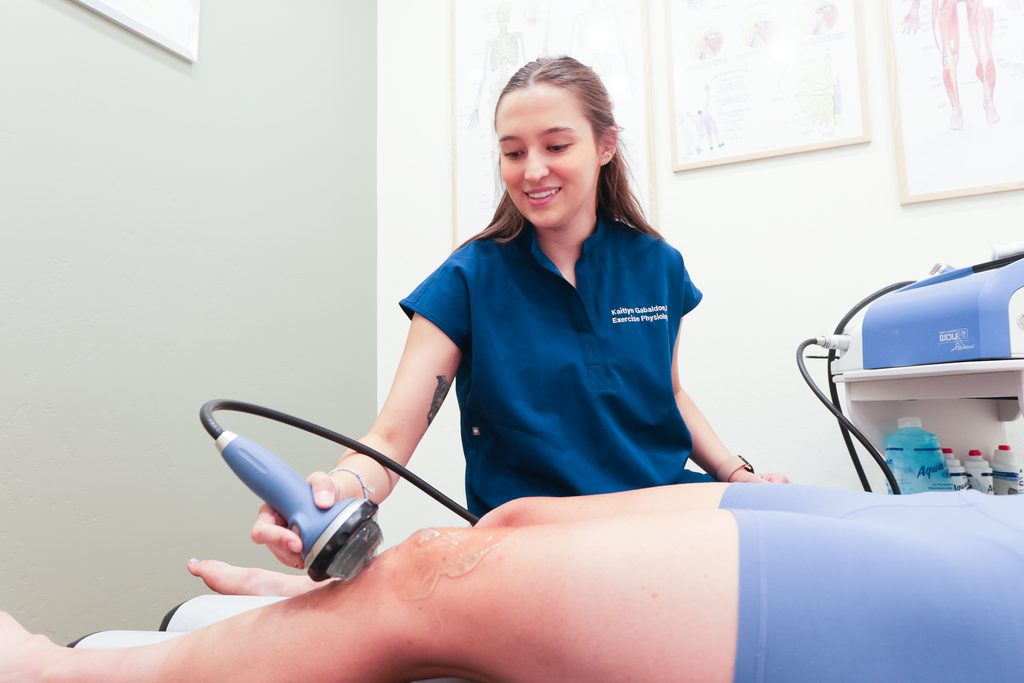
During treatment, gel is applied to the skin over the target area.
The shockwave applicator is then placed against the tissue, and acoustic pressure waves are delivered to the region.
Patients commonly describe the sensation as repetitive tapping or pulsing.
Certain areas can be sensitive—especially directly over an irritated tendon—but the treatment intensity can be adjusted based on tolerance.
Treatment itself is generally relatively short.
Shockwave is usually performed as a series of appointments rather than a one-time treatment.
Because we’re trying to stimulate a biological response within chronically irritated tissue, improvement may continue over several weeks rather than happening immediately after a session.
Do I Need to Stop Exercising During Shockwave Therapy?
Often, no.
Depending on the tendon and severity of symptoms, you may be able to continue many activities during treatment.
We may temporarily modify factors such as:
- Training volume
- Running mileage
- Hills
- Speed work
- Jumping
- Heavy lifting
- Repetitive movements
The goal is generally to find the right amount of activity—not automatically eliminate all activity.
That is particularly important for active patients.
We don’t want to simply get you comfortable while resting.
We want your tendon to become capable of doing the things you’re asking it to do.
A Different Approach to Tendon Pain in Durango
Living in Southwest Colorado makes movement part of everyday life.
Our patients run trails, ski, mountain bike, hike, climb, lift weights, play pickleball, work physically demanding jobs, and chase kids around.
When a tendon starts limiting those activities, being told to “just rest” can be incredibly frustrating.
At Animas Chiropractic and Collective, our approach is focused on figuring out what is limiting recovery and using the right combination of treatment and rehabilitation to address it.
Shockwave therapy gives us an additional non-surgical option for chronic tendon injuries that haven’t responded as expected to traditional approaches.
It isn’t magic.
It isn’t appropriate for everyone.
And it doesn’t replace the work of progressively rebuilding strength.
But for the right patient, it can be a valuable piece of the recovery process.
[BOOK AN APPOINTMENT]
Have a tendon injury that just won’t settle down?
Frequently Asked Questions About Shockwave Therapy for Tendon Injuries
Is shockwave therapy better than physical therapy for tendon injuries?
Shockwave therapy and rehabilitation serve different purposes and are often most useful when combined. Progressive strengthening helps rebuild the tendon’s ability to tolerate load, while shockwave therapy provides a mechanical stimulus to the affected tissue. Shockwave should generally be viewed as a complement to appropriate rehabilitation rather than a replacement for it.
Can shockwave therapy heal a tendon injury?
Shockwave therapy is intended to stimulate biological processes associated with tissue repair and remodeling, but no treatment can guarantee that a tendon injury will completely heal. Outcomes depend on the diagnosis, severity and duration of the condition, activity level, rehabilitation, and individual response to treatment.
How long does shockwave therapy take to work for tendon pain?
Results vary. Some patients notice changes during the treatment series, while others experience more gradual improvement over the following weeks. Chronic tendon conditions typically require time for tissue adaptation and rehabilitation.
Is shockwave better than a cortisone injection for tendinopathy?
The two treatments work differently, and neither is universally better. Corticosteroid injections are intended primarily to reduce inflammation and pain, while shockwave applies mechanical stimulation to targeted tissue. The appropriate treatment depends on the specific tendon condition and individual patient.
Is shockwave therapy an injection?
No. Shockwave therapy is non-invasive and does not involve needles or injections. Acoustic pressure waves are applied through an applicator placed against the skin.
Is shockwave therapy painful?
Treatment can be uncomfortable over sensitive or injured tissue, but intensity can typically be adjusted. Most patients describe the sensation as repetitive tapping or pulsing.
How many shockwave treatments are needed for tendon injuries?
Shockwave is commonly performed as a series of treatments rather than a single appointment. The appropriate number of sessions depends on the tendon being treated, how long symptoms have been present, the severity of the condition, and how the patient responds.
Can I exercise after shockwave therapy?
In many cases, yes. Patients may continue normal activities or a modified rehabilitation program following treatment. Specific recommendations depend on the injury and should be individualized.
Does shockwave therapy require downtime?
One advantage of shockwave therapy is that it generally requires minimal downtime. Temporary soreness following treatment can occur, but most patients can continue normal daily activities.
What tendon injuries can be treated with shockwave therapy?
Shockwave is commonly used for chronic tendon and connective tissue conditions such as Achilles tendinopathy, elbow tendinopathy, patellar tendinopathy, some shoulder tendon conditions, and plantar fascia-related heel pain. An examination is important to determine whether shockwave is appropriate for your particular condition.
When should tendon pain be medically evaluated?
Seek prompt evaluation if your pain began with a sudden pop or traumatic injury, you have major weakness or loss of function, there is significant swelling or bruising, or you suspect a tendon rupture. Persistent pain that isn’t improving with conservative care also deserves further evaluation.
Where can I get shockwave therapy for tendon injuries in Durango?
Animas Chiropractic and Collective offers orthopedic shockwave therapy in Durango, Colorado. We evaluate the injury first and determine whether shockwave therapy, rehabilitation, or another treatment approach is appropriate based on your diagnosis and goals.
