
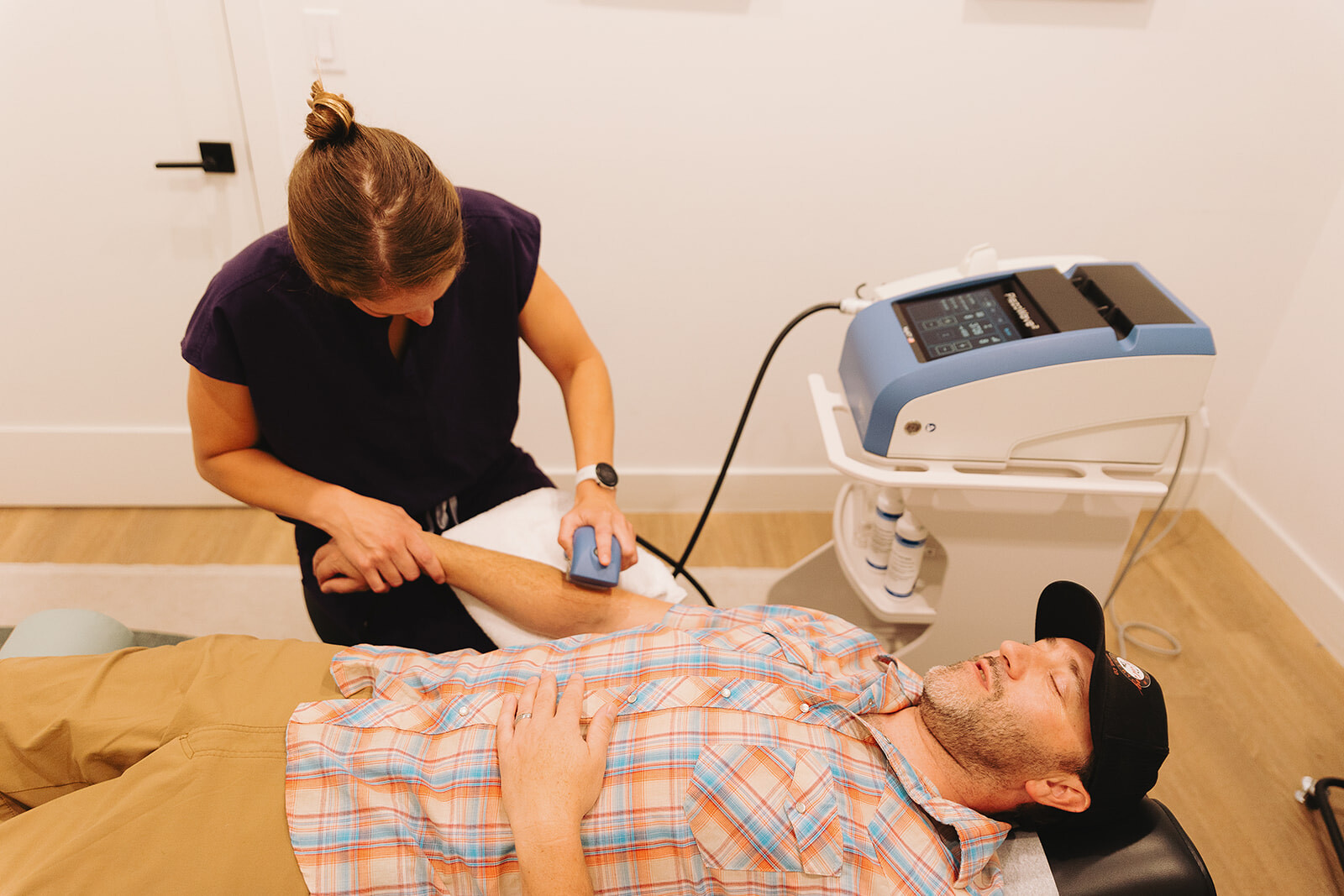
Book an Appointment to get a personalized treatment plan and start recovering from elbow pain today.
If you’re part of Durango’s active community—whether you’re golfing at Hillcrest, playing pickleball at the rec center, or lifting at the gym—you’ve probably seen how quickly elbow pain can sideline your routine. What starts as a mild annoyance during a swing or grip can gradually turn into something that affects everyday activities, from opening jars to shaking hands.
It’s around this point that many athletes begin searching for shockwave therapy elbow Durango options. And while shockwave therapy can be a powerful tool, the real key to recovery is understanding what’s actually happening in the elbow—and why it tends to linger if not treated correctly.
At our office, we don’t approach this as a one-treatment solution. Instead, we build a comprehensive, individualized plan designed to help you get back to playing, training, and competing as efficiently as possible.
What’s really causing your elbow pain
The terms “golfer’s elbow” and “tennis elbow” get thrown around a lot, but both conditions share a similar underlying issue: the tendon isn’t inflamed—it’s overloaded and not healing well.
On the inside of the elbow, golfer’s elbow involves the flexor-pronator muscles, which are heavily used in gripping and wrist flexion. This is why golfers, pickleball players, and even people doing repetitive manual work often feel pain in this area.
On the outside of the elbow, tennis elbow affects the extensor tendon, especially a muscle called the extensor carpi radialis brevis. This is commonly irritated with repetitive gripping, lifting, or racquet and paddle sports.
Despite the names, most people with these conditions aren’t actually playing golf or tennis. In Durango, we see it just as often in active adults, gym-goers, and people who spend long hours using their hands—whether that’s on a keyboard, tools, or a barbell.
What’s important to understand is that these are not primarily inflammatory conditions. Over time, repeated stress leads to small micro-tears in the tendon, and instead of healing properly, the tissue becomes disorganized and weaker. That’s why rest alone rarely solves the problem—and why symptoms often return as soon as activity picks back up.
Where shockwave therapy fits in
This is where shockwave therapy becomes particularly useful.
Shockwave therapy (ESWT) is a non-invasive treatment designed to stimulate healing in tissue that has essentially “stalled.” Instead of trying to reduce inflammation, it works by encouraging the body to restart a more normal repair process.
In cases of chronic elbow pain, shockwave therapy helps improve blood flow to an area that typically has poor circulation. It also stimulates the cells responsible for tissue repair and can reduce pain sensitivity, allowing patients to tolerate movement and exercise more comfortably.
Most patients require a short series of treatments—typically around four to five sessions—to notice meaningful improvement. It’s especially helpful for athletes who have been dealing with persistent symptoms that flare up every time they try to return to their sport.
Learn more about Shockwave Therapy
Why treatment needs to go beyond one modality
While shockwave therapy can be highly effective, it’s rarely the full solution on its own—especially for athletes.
Elbow pain is often the result of a bigger picture. For example, tight forearm muscles can increase strain on the tendon. Weakness in the shoulder or poor scapular control can change how force travels through the arm. Even subtle changes in swing mechanics for golf or pickleball can dramatically increase stress at the elbow.
That’s why we don’t treat elbow pain in isolation.
At our office, shockwave therapy is just one part of a broader plan. We look at how you move, how you train, and what your goals are. From there, we build a treatment strategy that may include soft tissue work, progressive strengthening, mobility training, and sport-specific guidance.
In some cases, we incorporate treatments like Dry Needling to address muscle tension that contributes to tendon overload. But the focus is always on combining the right tools at the right time—so your body can actually adapt and heal.
What recovery actually looks like for athletes
One of the biggest misconceptions about elbow pain is that you need to completely stop activity. In reality, most athletes do better with the right kind of movement rather than total rest.
Recovery is about finding the balance between loading the tendon enough to stimulate healing—but not so much that symptoms worsen.
This often means temporarily modifying certain movements, like limiting heavy gripping or high-volume swings, while gradually rebuilding strength in the forearm and surrounding muscles. Exercises like eccentric loading and controlled strengthening play a major role in restoring tendon capacity.
At the same time, we work on restoring mobility and addressing any contributing factors higher up the chain, like the shoulder or neck. As symptoms improve, we guide a gradual return to sport so you can build confidence without triggering setbacks.
When to consider shockwave therapy
If your elbow pain has been lingering for more than a few weeks, keeps coming back when you return to activity, or hasn’t improved with basic care, it may be time to consider a more targeted approach.
Shockwave therapy is particularly helpful for those stubborn cases where the tendon hasn’t healed properly and continues to flare with use. It can help accelerate progress—but only when paired with the right overall plan.
Book an Appointment if your elbow pain is limiting your ability to train, play, or perform at your normal level. We’ll help you determine whether shockwave therapy is appropriate and build a plan around your goals.
A practical message for Durango athletes
In a place like Durango, staying active is part of daily life. Whether it’s golf, pickleball, lifting, or just enjoying the outdoors, elbow pain can quickly take away from what you enjoy most.
The biggest mistake we see is waiting too long or relying on temporary fixes. By the time many athletes seek care, the problem has already become chronic.
Shockwave therapy can be a powerful tool to help move things in the right direction—but the real difference comes from addressing the root cause and following a plan tailored to your body and your sport.
Our goal is simple: help you recover efficiently and get back to doing what you love—without the frustration of recurring pain.
Book an Appointment today to start your personalized recovery plan.